


Safely Hang Heavy Mirrors Over 15–20 kg: English tips for expats


For a heavy mirror, the safest method is a distributed mounting system, a French cleat or several heavy-duty anchors matched to your wall type, never the basic plugs supplied in the box. Lift with a helper, confirm your wall type first, and test the fixing with a firm shake before you let go. The sections below walk through exactly which fixings suit solid walls, plasterboard, or metal stud partitions.
Table of Contents
Tools and materials you will need
Before you touch the drill, gather everything so you are not hunting for a bit halfway up a ladder. A few proper tools make the difference between a mirror that stays put and one that does not.
Tape measure, spirit level, pencil, and a stud-finder or strong magnet
Drill with masonry and wood bits sized to your chosen anchors
Screwdriver, dust sheet, safety glasses, and a second person to help lift
Fixings: universal masonry plugs, metal cavity anchors, toggles, or a French cleat/mounting rail, plus mirror clips if your frame has no hanging wire
Check the packet of each fixing for its rated load and the wall thickness it suits. A plug built for solid brick will not behave the same way in plasterboard, and the rating printed on the box assumes correct installation, not a rushed Sunday job.
How do you tell what kind of wall you have?
Knowing your wall type decides everything that follows, so it is worth five minutes before you reach for the drill.
Knock along the wall: a dull, solid sound usually means masonry or concrete; a hollow, drum-like sound means plasterboard.
Check behind a light switch or socket cover: the depth of the box often reveals whether you are looking at solid wall or a hollow stud partition.
Run a stud-finder or a strong magnet across the surface to locate timber studs, metal studs, or screw heads in the plasterboard.
Measure the board thickness where possible (a single layer is typically 9.5 to 12.5 millimetres; double layers are noticeably thicker).
If the magnet or stud-finder picks up metal studs rather than timber, note this, as it changes which fixing you need.
If you cannot confirm what is behind the wall, or you suspect hidden pipework or cabling, stop and get a professional opinion rather than drilling blind.
Which fixings work best for each wall type
Matching the fixing to the wall is the single factor that decides whether your mirror stays up. Get this wrong and no amount of careful drilling will save you.
Solid masonry or concrete: universal plugs such as Fischer’s UX range suit brick and concrete well.
Double-layer or reinforced plasterboard: Toggler-style hollow-wall anchors handle thicker, backed panels well, though you should still spread the load across a rail or several anchors.
Long or wide mirrors: a French cleat or mounting rail converts the hanging point into a line and spreads weight across the full width of the frame.
A properly sized universal plug in solid masonry can support roughly 20 to 50 kilograms per fixing, which is why a heavy mirror on a solid wall still benefits from two or more fixings rather than one. In plasterboard, the numbers drop: a metal cavity anchor typically offers around 25 kilograms per fixing, and this depends heavily on the plate thickness and the board behind it. Toggler-style anchors can show theoretical extraction values up to 100 kilograms on double plasterboard, but the safe working load in practice is a fraction of that figure, and it only holds if the anchor is fitted correctly with the right clearance behind the panel.
Step-by-step: hang a heavy mirror safely
Once you know your wall and your fixings, the actual hanging is mostly about careful measuring and patience.
Weigh the mirror if you can, or estimate from its size and frame material, and decide how many fixing points you need to distribute that weight safely.
Mark the final height and centre line on the wall with a pencil and spirit level, double-checking against the mirror’s actual hanging points rather than guessing.
Transfer the fixing positions precisely, then drill pilot holes matched to the anchor you have chosen, masonry bit for brick, the correct cavity bit for plasterboard.
Fit the anchor fully, whether that is tapping in a sleeve anchor or folding and inserting a toggle, then tighten until the fixing sits flush and firm.
Attach the rail or cleat to the wall first, check it is level, then hang the mirror onto it, or fix clips directly if your mirror has no rail.
With a helper supporting the weight, lift the mirror into place, check it sits level, and give it a firm shake test before letting go.
Write the mirror’s weight and the hanging date on a small label behind the frame, so you or a future tenant know what is holding it.
Pro Tip: Drill your pilot holes slightly undersized rather than oversized. A loose hole is the most common reason a cavity anchor fails to bite properly.
Safety checks and keeping records over time
A mirror that passes the shake test on day one can still loosen months later, so a little ongoing attention pays off.
Do an immediate shake test and look for cracking plaster, dust around the fixing, or screws that seem to be turning rather than tightening.
Re-check after any nearby renovation work, a heavy knock, or a stretch of unusually humid weather, since plasterboard can shift slightly.
Keep the anchor’s datasheet, a photo of the finished installation, and the dated note behind the mirror together for insurance or rental records.
If you ever see movement, hairline cracks spreading, or hear a scraping sound when the mirror is touched, take it down and get a professional to refit it properly.
When to call a pro instead of doing it yourself
Some jobs are worth handing over, particularly when the mirror is heavy, the wall type is uncertain, or you simply do not fancy spending a Saturday on a stepladder. Common triggers include mirrors over roughly 15 to 20 kilograms, old or uneven walls where you cannot confirm what is behind the plaster, rented properties where damage matters, and metal stud partitions that need a different approach entirely.
For jobs like this, we carry out an on-site check of the wall, choose and fit the correct anchor or French cleat system, test the finished hang, and leave you with a note of what was used and where. The same careful matching of fixing to wall applies to other wall-mounted jobs, including our TV wall mounting guide and the anchoring work covered in our Ikea Pax assembly case study. Before booking, have a photo of the wall, the mirror’s weight and size, and your preferred hanging height ready, it speeds up the quote considerably.
Our honest take on hanging a heavy mirror
Most advice online focuses on the drill bit and skips the part that actually causes failures: misjudging the wall. We have seen plenty of mirrors come down not because the anchor was wrong, but because nobody checked whether the wall was plasterboard, masonry, or a metal stud partition before buying fixings off a shelf.
The fixation on finding the single strongest anchor misses the bigger point. A French cleat with modest anchors, correctly matched to the wall, beats a premium toggle bolt used in the wrong spot every time. Distribution matters more than brute rated capacity.
If you take one thing from this, prioritise the wall test over the shopping trip. Spend five minutes knocking, checking a socket cover, and running a magnet across the surface before you buy anything. Everything else, the anchor choice, the number of fixing points, the drilling, follows naturally once you know what you are actually working with.
— Eutradesmen
Book a handyman: quick steps and local pages
We handle the measuring, drilling, and fixing so you do not have to second-guess your wall type on a stepladder. We provide clear quotes and punctual service, with no surprises on the invoice.
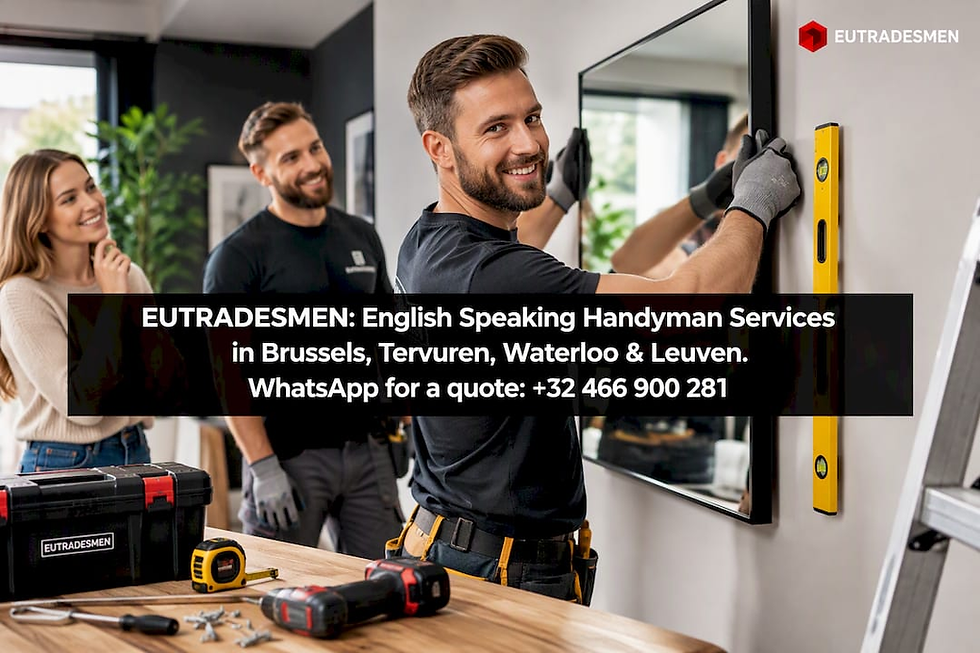
Booking is simple: snap a photo of your wall and mirror, send it to us on WhatsApp, and request a quote. Browse our Handyman services page for the full list of what we cover, or check our dedicated pages for Brussels Tradesmen and Tervuren Tradesmen if you are nearby. WhatsApp us on +32 466 900 281 and we will take it from there.
FAQ
What is the best way to hang a heavy mirror?
The best way is to match your fixings to your wall type and spread the weight across multiple points, using a French cleat or several heavy-duty anchors rather than a single hook. Always test the hang with a firm shake before trusting it fully.
How do you hang a 30kg mirror on a plasterboard wall?
A 30 kilogram mirror on plasterboard needs metal cavity anchors or toggles rated for the board thickness, ideally spread across two or more fixing points or a mounting rail. A single metal cavity anchor typically offers around 25 kilograms, so one fixing alone is unlikely to be enough.
Can you hang a heavy mirror on drywall?
Yes, provided you use anchors designed to grip behind the drywall rather than relying on the board itself, such as metal cavity anchors or toggles. For anything on the heavier side, distributing the load across a rail or several anchors is safer than a single central fixing.
How can I safely hang a heavy mirror on a solid wall?
On solid masonry, universal plugs sized correctly for the wall can support roughly 20 to 50 kilograms per fixing, so use at least two fixings for a heavy mirror. Drill pilot holes to the correct depth and diameter, and always shake-test the mirror once it is hung.
Sources
#HeavyMirrorHanging #BrusselsHandyman #TervurenTradesmen #EnglishSpeakingHandyman #WaterlooHandyman #LeuvenHandyman #DrywallMountingTips #FrenchCleatInstallation #ExpatHomeRepairs #Eutradesmen
Manufacturer and guidance pages to check anchor specs
Before buying fixings, check the manufacturer’s own load ratings against your measured wall thickness and mirror weight. Useful references include Fischer’s UX universal plugs for masonry, Fischer’s HM-S hollow-wall anchors for plasterboard, and a practical French cleat how-to guide for distributing load on wider mirrors. For background on how much weight drywall itself can realistically bear, this drywall load guide is a useful read, and for ideas on rail-based distributed mounting beyond mirrors, see these wall-mounted storage examples.
Contact Eutradesmen:
WhatsApp: +32 466 900 281 Telephone: +32 2 808 70 31 Email: info@eutradesmen.com
Follow us everywhere:
Instagram → https://www.instagram.com/eutrsdesmen/ Facebook → https://www.facebook.com/eutradesmen/ Threads → https://www.threads.com/@eutrsdesmen BlueSky → https://bsky.app/profile/eutradesmen.bsky.social TikTok → https://www.tiktok.com/@eutradesmenbelgium Pinterest → https://www.pinterest.com/eutradesmen/ Google Maps → https://maps.app.goo.gl/zjmYyCV1uADPj7QP6 YouTube → https://www.youtube.com/@Eutradesmen LinkedIn → https://www.linkedin.com/in/eutradesmen-belgium X Twitter → https://x.com/eutradesmen
Recommended


Comments