


American voltage adapters in Belgium: what you need to know

Updated: Jul 26

Why American voltage adapters matter in Belgium
Moving to Brussels, Waterloo, Tervuren, or Leuven with a bag full of American electronics? You need to act before you plug anything in. Belgium runs on 230V at 50Hz, nearly double the 120V/60Hz standard back home in the US. That gap is the whole problem.
Here is what every American expat needs to know upfront:
Plug shape mismatch: Belgian sockets are Type C and Type E (round pins). US plugs are Type A/B (flat pins). They will not fit without a physical adapter.
Adapter vs converter: A plug adapter only changes the shape of the plug. It does nothing to reduce voltage. These are two completely different things.
Dual-voltage devices: Most modern phones, laptops, and tablet chargers are labelled “Input: 100–240V, 50/60Hz.” Those only need a plug adapter.
Single-voltage devices: If your device label shows only “120V,” plugging it into a Belgian socket will cause immediate burnout or a fire hazard. A voltage converter is required.
Heat tools: Hair dryers, straighteners, and irons are rarely worth converting. Buying a local dual-voltage model is safer and cheaper than hauling a heavy transformer.
Pro Tip: Check the fine print on every charger brick before you pack. “100–240V” means you are fine with just a plug adapter. One number like “120V” means stop and buy a converter.
Table of Contents
Belgian electrical standards every American expat should understand
Belgium’s standard residential installation delivers 230V single-phase at 40A, giving a total capacity of 9.2 kVA. That is enough for everyday use, but large American appliances like tumble dryers or air conditioning units can push a circuit close to its limit.

The 50Hz frequency rarely affects digital electronics, but it can slow down motorised devices such as analogue clocks or older fans designed for 60Hz. Worth checking before you assume everything will run normally.

For expat electrical safety in Belgium, the golden rule is simple: read the device label first, buy the right adapter or converter second, and call a qualified electrician if you are unsure about load capacity.
Where to buy American voltage adapters in Belgium
You do not need to order online and wait. Adapters are widely available across Belgium:
Electronics retailers: Shops such as MediaMarkt and Fnac stock travel adapters and voltage converters in Brussels city centre and major retail parks near Waterloo and Leuven.
Airport and train stations: Brussels Airport (Zaventem) and Brussels-Midi station both carry travel adapters at newsagents and electronics kiosks, useful on arrival day.
Supermarkets and DIY stores: Brico and larger Carrefour branches often carry basic Type C/E adapters and multi-socket converters.
Online delivery: If you need a specific wattage converter for a heavy appliance, ordering via bol.com or Amazon.fr with Belgian delivery is often the quickest route.
For electrical improvements in your Belgian home, a qualified electrician can also advise on permanent solutions, such as installing additional sockets or upgrading circuit capacity, rather than relying on a chain of adapters.
Eutradesmen: English-speaking electrical help across Belgium
When a plug adapter is not enough, you need a professional who speaks your language and knows Belgian regulations inside out.
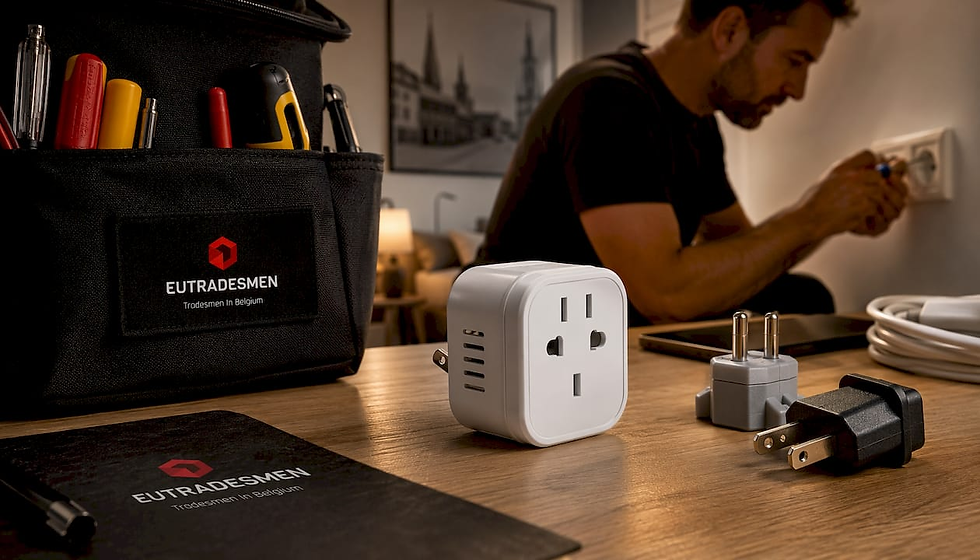
Eutradesmen’s English-speaking electricians have over 20 years of experience helping American and British expats in Brussels, Waterloo, Tervuren, and Leuven set up their homes safely. Whether you need a circuit capacity check before connecting a large American appliance, advice on voltage converters, or a full electrical compliance review, the team handles it all in plain English with transparent pricing. No language barrier, no guesswork.
Ready to solve your issue? WhatsApp +32 466 900 281 for a free quote today!
FAQ
Do I need a voltage converter for my phone in Belgium?
No. Almost all modern phone and laptop chargers are labelled “100–240V” and work worldwide with only a Type C or Type E plug adapter.
What happens if I plug a 120V device into a Belgian socket?
The device receives roughly double its rated voltage, which causes immediate burnout or trips the circuit breaker. Always use a voltage converter for single-voltage appliances.
Where can I buy a Type E plug adapter in Brussels?
MediaMarkt, Fnac, Brussels Airport, and most large supermarkets stock Type C/E adapters. They are inexpensive and widely available on arrival.
When should I call an electrician instead of using an adapter?
Call a qualified electrician when connecting large appliances such as American dryers or air conditioning units. Belgian residential circuits deliver a standard 9.2 kVA, and overloading them is a real safety risk.
Key takeaways
American voltage adapters in Belgium solve the plug shape mismatch, but only a voltage converter protects single-voltage US devices from Belgium’s 230V supply.
Point | Details |
Belgium’s voltage standard | Belgium runs on 230V/50Hz, nearly double the US standard of 120V/60Hz. |
Adapter vs converter | An adapter changes plug shape only; a converter steps down voltage for single-voltage devices. |
Dual-voltage check | If your device label reads “100–240V,” a plug adapter is all you need. |
Standard circuit capacity | Belgian residential installations deliver 9.2 kVA; large American appliances may need a capacity check. |
Eutradesmen support | English-speaking electricians in Brussels, Waterloo, Tervuren, and Leuven handle voltage assessments and safe installations. |
Contact Eutradesmen
WhatsApp: +32 466 900 281 Telephone: +32 2 808 70 31 Email: info@eutradesmen.com
Follow us everywhere
Instagram → https://www.instagram.com/eutrsdesmen/ Facebook → https://www.facebook.com/eutradesmen/ Threads → https://www.threads.com/@eutrsdesmen Bluesky → https://bsky.app/profile/eutradesmen.bsky.social TikTok → https://www.tiktok.com/@eutradesmenbelgium Pinterest → https://www.pinterest.com/eutradesmen/ Google Maps → https://maps.app.goo.gl/zjmYyCV1uADPj7QP6 YouTube → https://www.youtube.com/@Eutradesmen LinkedIn → https://www.linkedin.com/in/eutradesmen-belgium X Twitter → https://x.com/eutradesmen
#AmericanExpatsbelgium #VoltageAdapterBelgium #ElectricianBrussels #ExpatBelgium #ElectricianWaterloo #ElectricianTervuren #ElectricianLeuven #BrusselsExpat #BelgiumElectrical #TravelAdapterBelgium #EnglishElectricianBelgium #Eutradesmen #ExpatLifeBelgium #BrusselsLife #ElectricalSafetyBelgium
Recommended


Comments