


Tenant's role in garden upkeep: a practical guide

Updated: Sep 3
In Belgium, tenants are responsible for routine, day-to-day garden care — mowing, weeding, basic pruning, path sweeping, and litter removal. Landlords cover structural, safety-related, and age or force-majeure work such as major tree felling, rotten fence replacement, and drainage repairs. This split is confirmed by Brussels-Capital Region guidance, the Flemish rental lists, and the Walloon housing authority. The key exception: if a defect falls outside routine care, the tenant must report it promptly in writing. Failing to do so can shift liability for any resulting damage onto the tenant, even when the original cause was the landlord’s responsibility.
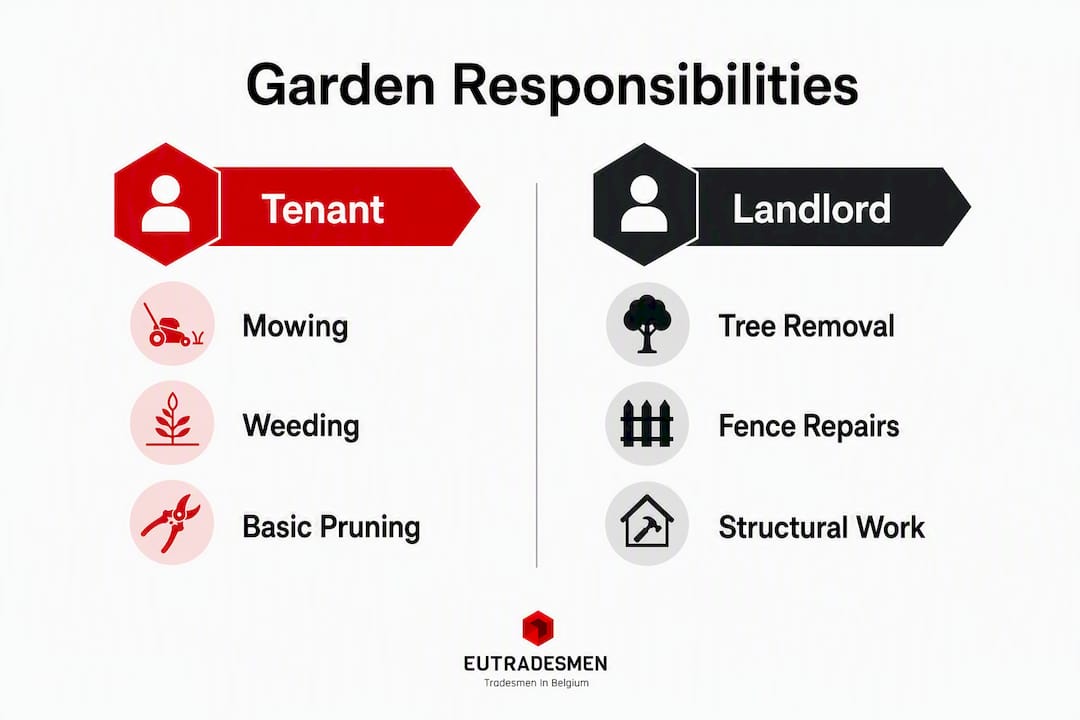
Table of Contents
Who does what in a rented garden?
The practical split is straightforward once you know the rules. ABRA’s introduction to the Belgian Decree confirms the general principle: day-to-day maintenance falls to the tenant; major structural renewals fall to the landlord. The lists are illustrative, not exhaustive, so borderline cases do arise.
Tenant duties (routine):
Mowing the lawn regularly and keeping edges tidy
Weeding flower beds, borders, and paving joints
Sweeping and clearing paths, patios, and steps
Removing litter, green waste, and emptying compost bins
Basic pruning of low shrubs and hedges at accessible height
Watering plants during dry spells and protecting them from frost
Keeping garden furniture and bins stored or tidy
Landlord duties (structural and major):
Felling or professionally pruning large or dangerous trees
Replacing rotten fence posts, collapsed walls, or structural gates
Repairing or replacing drainage systems and soakaways
Clearing gutters at height where ladder access is unsafe
Replacing dead trees that pre-date the tenancy
Fixing broken irrigation systems installed as part of the property
Boundary cases: A dead tree that was alive at move-in is the landlord’s responsibility to remove. A fence post that rots due to age is the landlord’s cost; one that rots because a tenant drove into it is the tenant’s. A blocked drain caused by leaf build-up from a tenant’s failure to clear gutters may shift liability to the tenant.
Pro Tip: Always report defects in writing — a WhatsApp message with a photo and a date stamp counts. If you spot a cracked fence post or a diseased tree, tell your landlord immediately. Silence can make you liable for the consequential damage.
What does “reasonable” garden upkeep actually include?
Tenants are expected to act as a bon père de famille (a responsible steward), which under Belgian legal commentary includes watering in dry spells and protecting plants from pests, unless an exceptional event such as a region-wide drought overrides that obligation.
Task | Recommended frequency |
Lawn mowing | Every 1–2 weeks (April–October) |
Edging and trimming | Monthly during growing season |
Weeding beds and borders | Every 2–4 weeks |
Sweeping paths and patios | Monthly, or after storms |
Emptying compost / green waste | Monthly, or when full |
Pruning low shrubs (under 2 m) | 2–3 times per year |
Watering (dry periods) | As needed — at least twice weekly |
Frost protection for tender plants | Before first frost (typically November) |
Practical limits to keep in mind:
Pruning low shrubs (under 2 metres) is a tenant task; anything requiring a ladder or chainsaw is not.
Removing moss from paths is listed as a tenant duty in the Walloon guidance; so is cleaning garden furniture.
Pest control for common garden pests (aphids, slugs) is a tenant responsibility; a serious infestation requiring certified treatment should be reported to the landlord.
For expats new to Belgian gardens, the essential gardening advice for expats in Belgium covers seasonal plant choices and local conditions that affect how often these tasks need doing.
What landlords should not expect tenants to do
Some demands go well beyond reasonable tenant duties in gardening. If your landlord asks for any of the following, it is worth checking your tenancy agreement and, if necessary, seeking advice.
Major landscaping: redesigning beds, installing new planting schemes, or laying new turf
Topsoil replacement or soil conditioning across the whole garden
Structural tree felling or high-stage pruning requiring specialist equipment
Heavy machinery use such as stump grinders, mini-excavators, or ride-on mowers on a domestic scale
Installing or replacing drainage or irrigation systems
Rebuilding or replacing fences, walls, or gates that have failed due to age
A tenant in Waterloo who is asked to remove a 15-metre oak that pre-dates the tenancy has a clear case that this is the landlord’s job. Similarly, a tenant in Tervuren asked to relay a collapsed retaining wall should push back in writing.
If a tenant volunteers to carry out work beyond their duties — say, planting a new hedge — that agreement should be documented in writing and signed by both parties, specifying who pays for materials and what happens to the plants at move-out.
What should your tenancy agreement say about the garden?
A clear garden maintenance clause prevents most disputes before they start. IPI practitioner guidance specifically recommends a dedicated Garden Annex to reduce ambiguity, particularly around seasonal duties and hedge or tree expectations.
What a Garden Annex should cover:
Who is responsible for mowing (tenant, or landlord-arranged service)
Seasonal responsibilities (leaf clearing in autumn, frost protection in winter)
Responsibility for pest and weed treatments
Obligation to report defects promptly in writing
Expected condition at move-out (same seasonal state as move-in)
Any specific plants, trees, or features the landlord wants preserved
Sample clause (editable fields in brackets):
Pro Tip: Check your local municipality’s bylaws before signing. Some communes in Brussels, Waterloo, and Leuven have specific rules on hedge heights, pavement obstruction, and green waste disposal. A quick search on your town hall’s website for “entretien jardin règlement communal” or “tuin onderhoud gemeentelijk reglement” will surface the relevant rules.
How to document the garden at check-in and check-out
The état des lieux (place description) is the single most important document for avoiding deposit disputes. Without thorough documentation, the tenant is at a disadvantage at move-out.
Step-by-step photographic checklist:
Photograph the entire garden from at least four corners before moving in.
Take close-up shots of every bed, lawn patch, fence panel, shed, gate, and paved area.
Include a scale reference (a ruler, a hand, or a known object) in shots of damage or wear.
Enable your phone’s timestamp or use a camera with automatic date/time stamping.
Back up all photos to cloud storage (Google Photos, iCloud, or OneDrive) immediately.
Write a brief description for each photo in the inventory report: condition, any existing damage, and the state of planted features.
Both tenant and landlord (or their agent) should sign the inventory report and each receive a copy.
What to record in the written inventory:
Lawn condition (length, bare patches, moss coverage)
Condition of all fences, gates, and walls (note any rot, cracks, or leaning)
State of any shed, greenhouse, or outbuilding
Planted features: hedges, trees, shrubs (height, health, species if known)
Irrigation equipment, taps, and hoses
Paths, patios, and steps (cracks, moss, staining)
Pro Tip: Keep copies of every garden maintenance receipt — lawn mowing invoices, pest treatment receipts, pruning quotes. If a dispute arises at move-out, these prove you maintained the garden to a reasonable standard throughout the tenancy.
How should you handle inspections and report garden problems?
Landlords in Belgium are entitled to inspect the property at reasonable intervals, typically every three to six months, with written notice given at least 48 hours in advance. Garden access should follow the same courtesy.
When you spot a garden problem as a tenant:
Photograph it immediately with a timestamp.
Send a written message (email or WhatsApp) to the landlord describing the issue and attaching the photo.
Keep a copy of every message sent and received.
If no response arrives within a reasonable period (seven to fourteen days for non-urgent issues), follow up in writing.
For safety issues — a leaning tree over a path, a collapsing fence near a public pavement — escalate immediately and request a written response within 48 hours.
If a landlord fails to act on a reported safety issue and a fine or injury results, the documented communication trail protects the tenant. Conversely, if a tenant fails to report a defect and it worsens, the tenant may bear the cost of remediation.
Seasonal maintenance: what needs doing and when
The Walloon housing authority requires tenants to return the garden in the same seasonal state as at move-in. Planning ahead by season makes that straightforward.
Season | Key tasks |
Spring (March–May) | First mow of the year, weed beds, prune winter-damaged shrubs, check fences after frost, clear moss from paths |
Summer (June–August) | Regular mowing (every 1–2 weeks), watering in dry spells, pest checks, trim hedges, empty compost bins |
Autumn (September–November) | Rake and remove fallen leaves (especially from drains and gutters), cut back perennials, protect tender plants, check drainage |
Winter (December–February) | Clear leaves from drains, protect outdoor taps from frost, check shed roofs after storms, report any storm damage promptly |
A summer move-out means leaving the lawn freshly mown and beds weeded. A winter move-out means clearing leaves from drains, protecting taps, and leaving the garden in the same tidy state documented at move-in. For a practical spring checklist, the spring garden tidy-up guide for Belgian gardens covers the most common first-of-season jobs.
Municipal rules, nuisance bylaws, and fines in Belgium
Local bylaws add another layer on top of the tenancy agreement. Belgian municipalities can fine residents for overgrown vegetation, obstructed pavements, or neglected gardens, and the Brussels-Capital Region guidance makes clear that tenants carry day-to-day responsibility.
How to find your local rules quickly:
Visit your commune’s official website (e.g., ixelles.brussels, commune-waterloo.be, tervuren.be, leuven.be).
Search for “règlement communal jardins” (French), “gemeentelijk reglement tuinen” (Dutch), or “garden maintenance local rules” in English.
Check for rules on hedge heights, pavement clearance, green waste collection days, and pest control obligations.
Ask at the town hall’s housing or environment desk if the website is unclear.
In Brussels, Waterloo, Tervuren, and Leuven, overgrown hedges that obstruct pavements or sight lines at junctions can trigger fines. If a municipality fines for pests or overgrowth and the tenancy clause assigns that duty to the tenant, the landlord may seek remedy from the tenant.
Pro Tip: If you receive a municipal notice about your garden, photograph it, date-stamp it, and send a copy to your landlord the same day. Even if the duty is yours, keeping the landlord informed protects you from any claim that you concealed a compliance issue.
Repairs, damage, wear and tear, and your deposit
Normal wear and tear is expected; damage from neglect is not. The distinction matters enormously at move-out.
Wear and tear vs. tenant damage — examples:
A lawn that fades slightly during a dry summer: wear and tear. Bare patches caused by months of neglect or chemical spills: tenant damage.
A fence panel that warps over several years: age-related wear. A panel broken by a tenant’s vehicle: tenant damage.
Moss appearing on a north-facing path over time: normal. A path completely overgrown because it was never swept: neglect.
Move-out checklist to protect your deposit:
Mow the lawn to a reasonable height before handing back keys.
Clear all weeds from beds, borders, and paving joints.
Remove all green waste, rubbish, and personal items from the garden.
Return the garden to the same seasonal state as documented at move-in.
Carry out any agreed final tasks listed in the Garden Annex.
What landlords need to make a valid deduction:
Timestamped move-in and move-out photos showing the difference
A professional quote or invoice for the remediation work
Evidence that the damage goes beyond normal wear and tear
If you believe a deduction is unfair, gather your maintenance receipts, your written communications, and your move-in photos, and contact a tenant advisory service (see the section below) before accepting any deduction.
When should you call a gardener or handyman?
Some garden jobs genuinely need a professional. Trying to do them yourself can cost more in remediation than the original job would have.
Hire a professional when:
The work involves height — pruning above 2 metres, clearing gutters, or inspecting a roof over a garden outbuilding.
A chainsaw or heavy machinery is needed (stump removal, tree felling, hedge cutting on a large scale).
Local bylaws require certified treatment — certain pest infestations or invasive species removal.
The Flemish rental guidance is clear that repairs carried out by tenants must meet professional standards; if they do not, the cost of putting them right falls on the tenant.
You are approaching move-out and want documented proof that the garden was returned in good condition.
What to expect from a professional garden quote:
A site visit (or photos for smaller jobs) to assess the scope
An itemised breakdown of labour and materials
A clear schedule and expected completion time
A written record you can keep for your inventory file
Eutradesmen’s gardening and landscaping service covers Brussels, Waterloo, Tervuren, and Leuven. A typical before-and-after example: a garden in Uccle that had been untouched for two tenancy years — waist-high weeds, overgrown hedges blocking the path, and a moss-covered patio — restored to a clean, tidy, lettable condition in a single day’s work. For summer-specific help, the summer garden assistance guide explains what a seasonal visit covers.
Tenant advisory services and gardening support in Central Europe
If you need guidance on your rights or obligations, these organisations can help:
Brussels-Capital Region Housing Department — be.brussels housing portal covers rental rights, repair divisions, and tenant obligations across the 19 communes.
Vlaams Huurdersbond (Flemish Tenants’ Union) — offers advice on Flemish rental law, including garden maintenance disputes; reachable via huurdersbond.be.
Syndicat National des Propriétaires et Copropriétaires (SNPC) — landlord-side guidance useful for understanding what landlords can and cannot demand; snpc.be.
CAW (Centrum Algemeen Welzijnswerk) — social welfare centres across Flanders and Brussels offering free legal and housing advice; find your local centre at caw.be.
Walloon Housing Authority — the logement.wallonie.be portal publishes the non-exhaustive repair list and tenant guidance in French.
Local CPAS / OCMW offices — every Belgian commune has a public social welfare centre that can refer tenants to free legal advice on housing disputes.
For practical garden work rather than legal advice, Eutradesmen’s English-speaking team in Brussels, Waterloo, Tervuren, and Leuven can quote for any job from a seasonal tidy-up to a full garden restoration.
Key takeaways - role of tenant in garden upkeep
Tenants handle routine garden care; landlords handle structural, safety, and age-related work — and a signed Garden Annex with timestamped photos at move-in is the single most effective way to protect both parties.
Point | Details |
Document at move-in | Take timestamped photos of every garden feature and get both parties to sign the inventory. |
Maintain routine tasks | Mow, weed, sweep, and prune low shrubs regularly throughout the tenancy. |
Report problems in writing | Send a dated message with a photo the moment you spot a defect — silence can shift liability to you. |
Add a Garden Annex | A clear clause in the tenancy agreement specifying seasonal duties and move-out condition prevents most deposit disputes. |
Call a pro for safety work | Eutradesmen provides English-speaking gardeners and handymen across Brussels, Waterloo, Tervuren, and Leuven for any job beyond routine DIY. |
Why clear garden rules matter more than most expats expect
Role of tenant in garden upkeep - Many expats arriving in Brussels or Waterloo assume a garden is a bonus — something to enjoy, not a legal obligation. The reality is different. Belgian rental law places genuine duties on tenants, and the état des lieux is taken seriously by landlords, agents, and courts alike. The most common mistake is arriving without a thorough move-in inspection: no photos, no signed inventory, no Garden Annex. Six months later, a hedge has grown two feet and a fence post has started to lean, and suddenly it is unclear who is responsible for what.
The Garden Annex is not bureaucracy for its own sake. It is the document that stops a reasonable landlord from making an unreasonable claim, and it stops an unreasonable landlord from making one successfully. Expats in particular tend to underestimate how seasonal expectations work here: returning a garden in winter without clearing the drains or protecting the taps is not “leaving it tidy” under Belgian standards. Eutradesmen’s teams in Brussels, Tervuren, Waterloo, and Leuven see this regularly — gardens that were genuinely well-intentioned but undocumented, leading to deposit disputes that a single afternoon of professional work and a signed checklist would have prevented.
Eutradesmen: English-speaking garden and home services in Belgium
When a garden has been left to grow wild between tenancies, or a tenant needs a professional finish before handing back the keys, Eutradesmen is the practical solution. Rather than spending a weekend fighting overgrown hedges or hiring equipment you have never used, you get an English-speaking team who know exactly what Belgian landlords and letting agents expect.
Eutradesmen covers Brussels (including Ixelles, Uccle, and Schaerbeek), Waterloo, Tervuren, and Leuven. Services include professional gardening and landscaping, handyman repairs, plumbing, electrical work, painting and decorating, satellite TV and Wi-Fi setup, and furniture assembly. Every team member speaks English, which means no miscommunication about what you need done or how you want it left.
A standard garden quote includes a site visit or photo assessment, an itemised price for labour and materials, and a clear schedule. For a full garden cleanup and restoration before a move-out inspection, contact Eutradesmen for a free quote today.
Ready to solve your issue? WhatsApp +32 466 900 281 for a free quote today!
Useful sources and where to check local rules
Use these official pages to verify your obligations for your specific municipality and region:
Brussels-Capital Region: division of repairs between tenant and landlord — the primary reference for Brussels tenants and landlords.
Flemish rental list of small repairs (KU Leuven summary) — covers Flanders, including Leuven and Tervuren.
ABRA introduction to the Belgian housing decree — a clear English-language summary of the general rules.
Clabots Advocaten: garden maintenance in rental properties — Belgian legal commentary on the bon père de famille standard.
Search terms to find your commune’s rules:
Contact Eutradesmen
WhatsApp: +32 466 900 281 Telephone: +32 2 808 70 31 Email: info@eutradesmen.com
Eutradesmen serves Brussels (Ixelles, Uccle, Schaerbeek), Waterloo, Tervuren, and Leuven. English-speaking teams, fast local response, and transparent pricing on every job — from a seasonal garden tidy to a full handyman visit.
Follow us everywhere
Instagram → https://www.instagram.com/eutrsdesmen/
Facebook → https://www.facebook.com/eutradesmen/
Threads → https://www.threads.com/@eutrsdesmen
Pinterest → https://www.pinterest.com/eutradesmen/
Google Maps → https://maps.app.goo.gl/zjmYyCV1uADPj7QP6
YouTube → https://www.youtube.com/@Eutradesmen
X Twitter → https://x.com/eutradesmen
Follow Eutradesmen to see before-and-after garden transformations, client reviews, and seasonal tips for expats across Belgium.
FAQ
Are tenants responsible for maintaining the garden in Belgium?
Yes. Brussels-Capital Region guidance and the Flemish and Walloon rental lists all confirm that tenants are responsible for routine garden maintenance — mowing, weeding, pruning low shrubs, and keeping paths clear. Landlords handle structural repairs and age-related work.
Do tenants have to cut the grass in a rented property?
Yes, regular lawn mowing is a standard tenant duty under Belgian rental law. The Walloon non-exhaustive list and the Flemish rental guidance both include grass cutting as a tenant responsibility throughout the growing season.
What garden work is the landlord responsible for?
Landlords are responsible for major tree work, structural fence or wall repairs, drainage and gutter work at height, and any repair caused by age or force majeure. A rotten fence post that fails due to age is the landlord’s cost; one damaged by a tenant is not.
What is a Garden Annex and do I need one?
A Garden Annex is a written addition to the tenancy agreement that specifies exactly who does what in the garden, including seasonal duties and the expected condition at move-out. IPI practitioner guidance recommends one for any property with a garden, as it prevents the most common deposit disputes.
How do I protect my deposit when I move out of a property with a garden?
Return the garden in the same seasonal condition documented at move-in, with timestamped photos as evidence. Mow the lawn, clear weeds, remove green waste, and carry out any tasks listed in your Garden Annex. Keep all maintenance receipts throughout the tenancy as proof of regular upkeep.
#TenantGardenRights #RentalGardenBelgium #ExpatsInBelgium #BrusselsExpats #WaterlooExpats #TervurenExpats #LeuvenExpats #GardenMaintenanceBelgium #BelgiumRentalLaw #EutradesMen #EnglishHandymanBrussels #GardeningBrussels #GardeningWaterloo #GardeningTervuren #GardeningLeuven #ExpatLivingBelgium #RentalTipsBelgium #LandlordTenantBelgium #GardenUpkeepBelgium #EnglishSpeakingTradesmenBelgium
Recommended


Comments