


Loss of signal Satellite TV repairs in Belgium: expert repair guide

Updated: May 14

Moving to Belgium and suddenly losing your satellite TV signal is one of those frustrations nobody warns you about. One minute you are watching your favourite channels from home, and the next the screen goes blank, or worse, you are staring at a confusing error message in French or Dutch. Many English-speaking expats immediately assume the satellite dish is broken and start searching for repair services, only to discover the problem was actually their internet connection all along. This guide will walk you clearly through how to identify what has gone wrong, fix what you can yourself, and find reliable, English-speaking help when you need it.
Table of Contents - Loss of signal Satellite TV repairs in Belgium
Key Takeaways
Point | Details |
Signal loss diagnosis | Always separate satellite TV issues from internet/streaming problems for faster troubleshooting. |
Repair checklist | Verify cabling, dish alignment, and receiver status before calling a technician. |
Best service selection | Choose English-speaking, experienced satellite TV technicians for reliable repairs in Belgium. |
Avoid common pitfalls | Don’t overlook network/ISP faults when troubleshooting TV outages; it can save you money and time. |
Understanding satellite TV signal loss in Belgium
Loss of signal Satellite TV repairs in Belgium - Before you can fix the problem, it helps to understand exactly what type of TV service you have. This distinction matters more than most people realise, and getting it wrong can waste a lot of time and money.
Satellite TV receives its signal via a physical dish mounted on your roof, wall, or balcony. The signal travels from a satellite in orbit, through the dish, down a coaxial cable (a thick, round cable), and into your receiver box. When this system works, it works beautifully regardless of your internet connection. When it does not work, the culprit is almost always physical: the dish, the cable, the connectors, or the receiver itself.
IPTV (Internet Protocol Television) is completely different. It delivers TV channels through your broadband internet connection, using an app or a set-top box that relies on your Wi-Fi or wired network. If your internet is slow or drops out, your TV picture will buffer, freeze, or fail to load entirely.
Knowing the difference is the foundation of smart troubleshooting. Common symptoms of genuine satellite signal loss include:
A completely blank or black screen with no error message
An on-screen message saying “No signal” or “Searching for satellite”
Pixelation or freezing of the picture that occurs even on sunny days
Loss of all channels simultaneously, not just a few
The receiver box displaying an error code related to signal strength
In contrast, symptoms that typically point to an internet or IPTV issue include buffering circles, timeout messages, and individual channels dropping in and out. As symptom-first diagnostics for Belgian viewers confirm, distinguishing satellite TV issues from internet and streaming issues is crucial, because timeouts and buffering are most often network and ISP-related faults, not satellite ones.
Expats are particularly vulnerable to this confusion because many arrive in Belgium with a mix of services. They may use a UK satellite dish for familiar channels while also subscribing to a Belgian streaming service for local content. When the TV stops working, it is not always obvious which part of the system has failed. If you have been repairing satellite TV in Brussels for years, you quickly recognise that the first question is always: “Which service exactly has gone down?”
Our free UK satellite TV guide is also a useful starting point if you are trying to receive British channels through a satellite dish in Belgium and want to understand the full picture before picking up the phone.
Diagnosing signal problems before calling a technician
Running a few basic checks yourself before calling a professional can save you time, money, and the frustration of waiting for a visit that turns out to be unnecessary. Here is a straightforward process to follow.
Step 1: Check if the issue is with one channel or all channels If only one or two channels have disappeared, the problem may be that those particular channels have changed their transmission frequency, or their free-to-air status has changed. This is common with some European channels. If all channels are gone, that strongly points to a dish, cable, or receiver fault.
Step 2: Reboot your receiver This sounds almost too simple, but it resolves a surprising number of signal issues. Switch your receiver off at the mains (not just with the remote), wait a full 60 seconds, and power it back on. Receivers can hang or lose their lock on the satellite signal after a power fluctuation, and a full reboot often restores everything.
Step 3: Check the signal strength menu Most satellite receivers have a signal strength and signal quality display buried somewhere in the settings or installation menu. Navigate to this screen while the receiver is connected. A healthy signal typically shows strength above 60 per cent and quality above 50 per cent. If both readings are at zero, the dish is not receiving anything at all. If strength is present but quality is low, the dish may be slightly misaligned or a cable connector may be corroded.
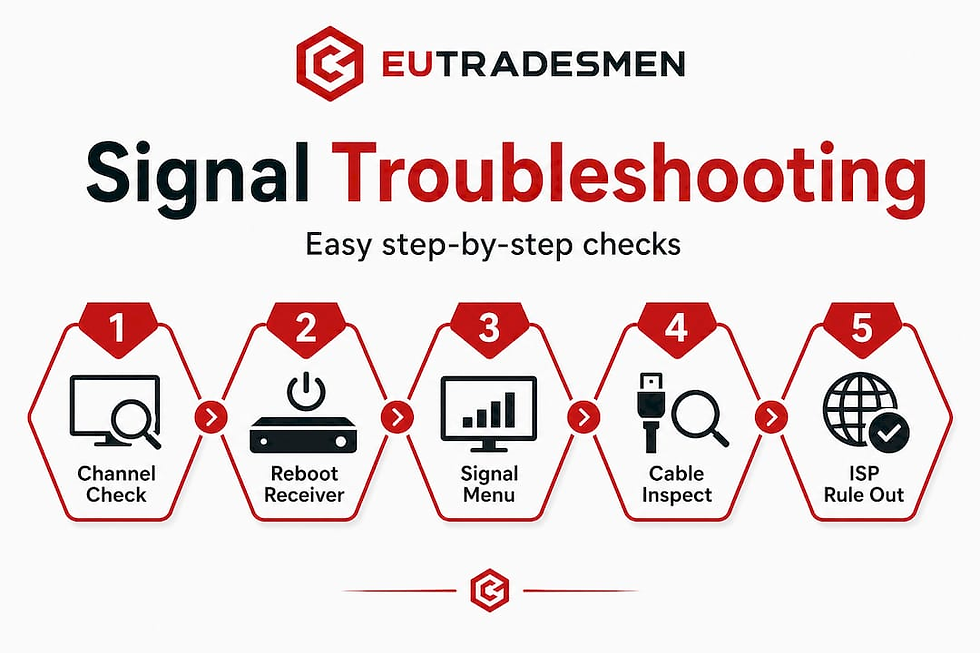
Step 4: Inspect your cables and connectors visually Check the coaxial cable where it enters your receiver and where it exits your property. Look for obvious damage: kinks, cuts, water ingress, or connectors that have worked loose. A bent or corroded connector can cut signal strength significantly without being immediately obvious.
Step 5: Rule out your ISP and network Many expats overlook this. Ruling out network or ISP faults before calling a satellite engineer is consistently recommended, because a surprising number of perceived satellite problems turn out to be broadband issues affecting IPTV services. Check whether your home Wi-Fi is working normally and whether your internet provider has reported any outages in your area.
Pro Tip: Before arranging any repair visit, take a photo of your signal strength screen and the physical dish from ground level. This gives a technician useful information before they arrive and can speed up the diagnosis considerably.
For broader UK satellite TV troubleshooting advice tailored to expats, our dedicated guide covers the specific channels and dish setups most commonly used in Belgium. If you want a clear picture of typical repair costs in Belgium before committing to a callout, that resource will give you realistic figures to work with.
Common causes of signal loss in Belgian homes
Once you have run the basic checks, it helps to understand the most likely reasons your signal has disappeared. Belgian weather and housing styles create a specific set of challenges that differ from what many expats experienced back home.
Cause | How common | Typical fix |
Storm or high wind | Very common | Re-alignment or dish refit |
Rain fade (heavy rain) | Common, temporary | Wait for weather to pass |
Snow or ice on dish | Seasonal, winter | Clear dish surface gently |
Dish misalignment | Very common | Professional re-alignment |
Corroded cable connectors | Common in older homes | Replace connectors |
Damaged coaxial cable | Moderate | Replace cable run |
Faulty LNB unit (the arm on the dish) | Moderate | Replace LNB |
Receiver fault or software error | Less common | Reboot or factory reset |
Interference from nearby object | Occasional | Relocate dish |
Environmental factors are among the leading causes of signal disruption in Belgium. The country experiences significant rainfall throughout the year, and strong winds are common, particularly in winter. A phenomenon called “rain fade” occurs during very heavy rainfall when moisture in the atmosphere absorbs part of the satellite signal. This is usually temporary and the picture returns once the rain eases. Snow and ice settling on the dish surface, however, can block the signal entirely until the dish is cleared. Do not use hot water or sharp tools to clear ice from the dish face as this can permanently damage the surface.
Dish misalignment is one of the most frequently seen causes of signal loss in Belgian homes. Satellite dishes point at a very specific spot in the sky, and even a small shift of a few degrees can cause complete signal loss. High winds, vibration from nearby construction, accidental contact, or simply the natural settling of a wall bracket over years can gradually knock a dish off its precise pointing angle. This is rarely something a homeowner can fix safely without specialist equipment.

Technical cable and connector issues are particularly common in older Belgian properties, especially the traditional terraced houses found throughout Brussels neighbourhoods like Ixelles, Schaerbeek, and Uccle. Coaxial cables that run externally are exposed to years of weather, and the waterproofing on connectors deteriorates over time. Corroded connectors cause intermittent signal, which can be frustrating because the TV sometimes works and sometimes does not, making diagnosis feel like a guessing game.
User-related causes are more common than people like to admit. These include accidentally moving the dish while cleaning gutters or a window, an aerial or tree branch growing into the dish’s line of sight, or simply unplugging the wrong cable during a home reorganisation. Check your satellite TV installation tips to understand what an ideal installation looks like, so you can spot if something has physically changed. If you need to find satellite TV professionals in your area quickly, our directory of trusted technicians is a good place to start.
Choosing reliable satellite TV repair services in Belgium
Once you have a reasonable idea of what has gone wrong, choosing the right person to fix it properly is the next important step. For English-speaking expats, this can feel daunting, especially if previous encounters with Belgian tradespeople have involved communication barriers or uncertainty about pricing.
Here is what to look for when choosing a satellite TV repair technician in Belgium:
English communication: The technician should be able to explain the problem clearly and give you a written or verbal quote in English before starting work
Experience with expat setups: UK, Irish, and American satellite configurations differ from Belgian domestic installations; your technician should be familiar with these
Transparent pricing: Look for services that offer a clear callout fee and an hourly rate, with no hidden costs
Responsiveness: A good technician responds to enquiries within 24 hours and can usually visit within a few days
References or reviews: Check for Google reviews or testimonials from other expats in Belgium
Service type | Language | Expat experience | Typical response time | Cost range |
General Belgian electrician | Dutch or French | Low | 1 to 2 weeks | Varies widely |
Large telecoms provider | Mixed | Low | 1 to 3 weeks | Often high |
Expat-focused handyman service | English | High | 1 to 3 days | Clear and fair |
As experienced expat-focused specialists confirm, locating qualified professionals is essential for restoring service, especially for English-speaking expats who are unfamiliar with Belgian home repair norms. Calling a general electrician who has never worked on a satellite installation, or a large telecoms company whose engineer only speaks French, can result in delays, miscommunication, and costs that were never agreed upfront.
What you can generally expect from a professional repair visit includes an initial diagnostic check, confirmation of the fault with a clear explanation, a quote before any work begins, and a test of the signal after the repair is complete. For most standard repairs like a re-alignment or connector replacement, the job can be completed in a single visit. More complex issues like a full cable run replacement may require a second appointment.
For detailed guidance on satellite repair pricing, our pricing guide covers typical callout fees and repair costs across Belgium for 2026. If you are based in Brussels, Waterloo, or Tervuren, our guide to installation and repair tips in these areas provides city-specific advice that is directly relevant to your location.
What most expats miss when troubleshooting satellite TV loss
Here is something we see repeatedly: an expat calls us in a panic, convinced their satellite dish has been knocked out of alignment by a recent storm. We arrive, check the dish, find it pointing perfectly. We then ask a few questions and discover the TV service that has gone down is actually an IPTV subscription delivered over the internet, not a true satellite feed at all. The actual satellite dish, used for different channels, is working fine.
This mix-up is genuinely very common. Modern expat TV setups often layer multiple services on top of each other: a physical satellite dish for UK channels, a Belgian cable or IPTV subscription for local content, and a streaming service for everything else. When one of these fails, the natural assumption is that the most visible piece of hardware, the dish on the wall, is to blame.
The uncomfortable truth is that calling a satellite engineer for what turns out to be an internet or ISP problem costs you a callout fee and achieves nothing. As symptom diagnostics for Belgian viewers clearly show, symptoms like timeouts and buffering can be network-related, not satellite faults at all.
Our honest advice: always check your internet connection first. Open a browser on your phone or laptop and see if basic websites load normally. Check whether your ISP has any reported outages. Only after ruling out network problems should you consider that the satellite system itself has failed. This simple habit can save you the cost of an unnecessary callout and the frustration of a wasted afternoon.
The other thing many expats miss is that small issues, left unattended, become bigger and more expensive problems. A slightly corroded connector today can develop into a completely failed cable run in two years. If a technician flags a minor issue during a repair visit, it is worth addressing it at the same time. Our expat TV success stories show consistently that proactive maintenance keeps satellite systems reliable for many years without major intervention.
Connect with expert satellite TV repair services in Belgium
If you have run through the diagnostics in this guide and still cannot restore your signal, or if you simply want a qualified, English-speaking professional to handle the repair from the start, we are ready to help.

At Eutradesmen, we specialise in satellite TV repairs and installations for English-speaking expats and residents across Belgium, including Brussels, Waterloo, Tervuren, Leuven, Mons, and Antwerp. Our technicians communicate clearly in English, provide transparent quotes before starting any work, and are experienced with the specific dish and receiver setups that expats typically use. Whether you need a simple re-alignment or a full cable replacement, booking is straightforward. As a trusted English-speaking handyman service in Belgium, we cover a wide range of home services beyond TV repairs. If you are in Brussels and need quick help, our Brussels English-speaking handyman team can often visit within 24 to 48 hours.
Frequently asked questions
How can I tell if my TV signal loss is a satellite issue or an internet problem?
Buffering and timeouts are usually internet-related faults, while a sudden and complete loss of all channels points to satellite dish or cable issues. Checking whether your broadband is working normally is always the first step.
What are the most common reasons for satellite TV signal loss in Belgium?
Dish misalignment, bad weather, and faulty or corroded cables are the leading causes of signal loss in Belgian homes. High winds and heavy rain are particularly frequent culprits in Belgium’s climate.
Are there English-speaking satellite TV repair services available in Belgium?
Yes, English-speaking technicians and specialist services like Eutradesmen offer satellite TV repairs specifically designed for expats and non-Dutch or French-speaking residents across Belgium.
What should I check before contacting a satellite TV repair technician?
Rule out network and ISP faults first, then check your cables and connectors visually, and reboot your receiver fully before arranging a professional visit. This simple process can save you the cost of an unnecessary callout.
Contact Eutradesmen:
WhatsApp: +32 466 900 281 Telephone: +32 2 808 70 31 Email: info@eutradesmen.com
Follow us everywhere:
Instagram → https://www.instagram.com/eutrsdesmen/ Facebook → https://www.facebook.com/eutradesmen/ Threads → https://www.threads.com/@eutrsdesmen Bluesky → https://bsky.app/profile/eutradesmen.bsky.social TikTok → https://www.tiktok.com/@eutradesmenbelgium Pinterest → https://www.pinterest.com/eutradesmen/ Google Maps → https://maps.app.goo.gl/zjmYyCV1uADPj7QP6 YouTube → https://www.youtube.com/@Eutradesmen LinkedIn → https://www.linkedin.com/in/eutradesmen-belgium X Twitter → https://x.com/eutradesmen
#SatelliteTVBelgium #ExpatBelgium #SatelliteTVRepair #BrusselsSatelliteTV #EnglishHandymanBelgium #ExpatBrussels #SatelliteDishRepair #TVSignalLoss #EnglishSpeakingTechnicianBelgium #BrusselsExpat #WaterlooExpat #TervurenExpat #LeuvenExpat #AntwerExpat #MonsExpat #UKTVBelgium #SatelliteInstallBelgium #Eutradesmen #EnglishHandymanBrussels #SatelliteRepairBrussels #ExpatLifeBelgium #BelgiumExpat #IxellesBrussels #UccleBrussels #SchaerbeekBrussels #SatelliteTVFix #TVRepairBelgium #ExpatServices #HomeTVRepair #EnglishTechnicianBrussels
Recommended


Comments